

 VN
VNNo products in the basket.
Throughout the history of urban development, there are infrastructure projects that do not merely change how a city moves — they change how the real estate market surrounding them revalues itself. Melbourne is experiencing one of the largest infrastructure investment phases in the city’s history. And at the centre of that phase, at least for the Southbank area, is the Metro Tunnel project — a multi-billion dollar new underground rail line being built to solve the traffic congestion problem that has plagued the city centre for decades.
Among the stations on this line, Anzac Station holds the most geographically distinctive position — and the most direct impact on the Southbank precinct.

What Is the Metro Tunnel and Why Does It Matter?
The Metro Tunnel is a 9 km underground rail line running through the heart of Melbourne, connecting existing train lines via a new loop to relieve the city’s overloaded rail network. The line features 5 new stations, with Anzac Station located at Domain — right alongside the Southbank and Arts Precinct areas.
Before the Metro Tunnel, getting from Southbank to other parts of Melbourne relied primarily on surface trams and buses — convenient to a degree, but unable to compete with the speed and reliability of underground rail. When the Metro Tunnel becomes fully operational, that picture changes entirely.
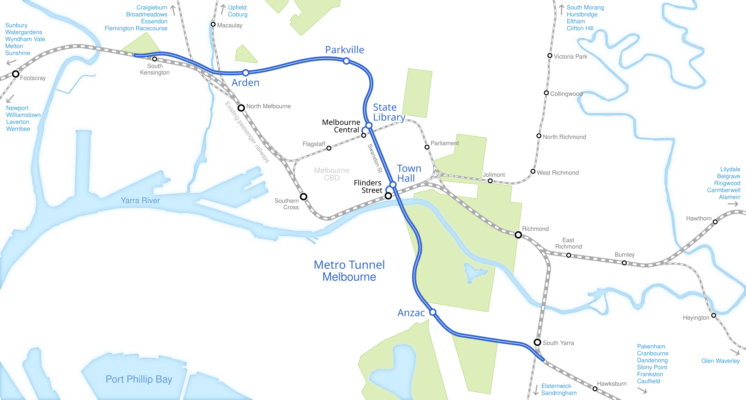
Anzac Station: Southbank’s New Gateway
Anzac Station is designed to serve not only Southbank residents but also the large number of people who come to the area daily — students, office workers, tourists, and attendees of events at the Arts Precinct. The station sits at the intersection of Domain Road and St Kilda Road, creating a new connectivity hub for the entire southern side of Melbourne.
From Anzac Station, residents can travel directly to:
- Melbourne’s economic centre: just a few minutes away
- Northern residential and commercial areas such as Parkville and Brunswick
- South-eastern suburbs such as Carnegie, Caulfield, and Dandenong
- Seamless connections to Melbourne’s entire metropolitan rail network
This is a level of connectivity that Southbank has never had before — and when an area suddenly becomes significantly more accessible, the property market tends to respond in one direction only.
Infrastructure and Property Values: Lessons from Other Cities
The relationship between new public transport infrastructure and surrounding property values is not theoretical — it is a trend well documented across many major cities around the world.
In Sydney, when the Northwest Metro opened in 2019, property prices in areas around the new stations rose significantly within 2–3 years. In London, areas along the Crossrail (Elizabeth Line) corridor saw house price growth that substantially outpaced the rest of the city both during construction and after opening. In Singapore, Hong Kong, and Tokyo, properties within walking distance of Metro stations are consistently valued higher than surrounding areas.
Melbourne is no exception. And Southbank, with Anzac Station now operational, sits precisely in the position that history suggests is where significant price appreciation tends to occur.
Looking Back to Look Forward
This is not the first time Melbourne has made a major investment in urban rail infrastructure. And each time it has happened, areas within the zone of influence have benefited in predictable ways — though not always immediately. In that context, Verdé’s address at 85 Coventry Street — just 600 metres from Anzac Station — carries more concrete significance than a number on a map.
Six hundred metres is a comfortable 7–8 minute walk. For residents, that translates to genuine everyday convenience: no need to worry about private car parking, no dependence on bus timetables. For investors, it is one of the key parameters that property specialists use to define the “benefit zone” of new infrastructure — and 600 metres sits firmly within that zone.
Check it out for more information about Verdé project:
VERDÉ – The Green Oasis at the Heart of Melbourne’s Arts Precinct